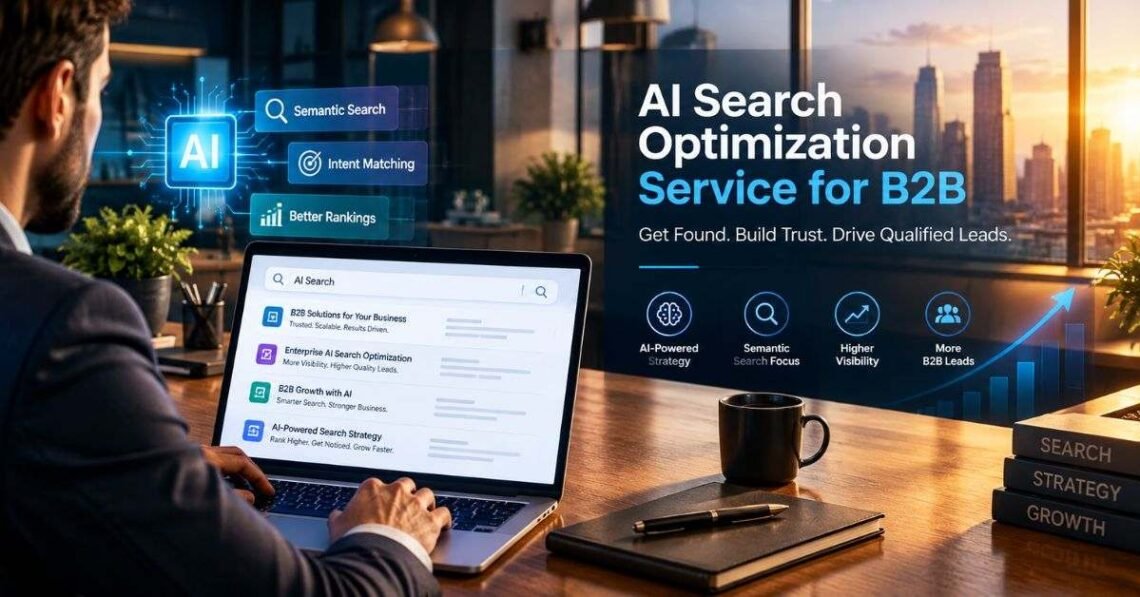
Your buyers have changed how they research. Before they ever talk to sales, many business buyers ask an AI tool like ChatGPT, Gemini, Perplexity, Claude, or Google’s AI Overviews to explain a problem and suggest vendors. If the answer names your rivals and skips you, you lose the deal before you even know it existed.
That is why more companies are looking at ai search optimization services for B2B. These services help AI tools find, understand, trust, and mention your brand. They build on classic SEO, but they add new work, such as fixing what AI says about you and earning mentions on sites that AI reads.
This guide uses plain words. You will learn what the work includes, how AI picks brands, what to fix first, how to measure progress, what it costs, and which mistakes to avoid. We also reviewed several top pages on this topic. This guide adds what they were missing: a clear starting plan, easy tables, and honest limits on what anyone can promise.
Let’s start with the basics.
What Is AI Search and Why Do B2B Buyers Use It
AI search optimization is the work of making your brand easy for AI tools to find, understand, trust, and mention in their answers. You may also see it called generative engine optimization (GEO) or answer engine optimization (AEO). The names differ, but the goal is the same: be part of the answer.
Old search gave people a list of links. AI search gives them one written answer, often with a few sources. A buyer might type, “What should I look for in a payroll tool for a 200-person company?” and get a short list of vendors in seconds. Then they can ask follow-up questions in the same chat.
B2B buying takes weeks or months, and many people join the decision. The finance lead asks about price. The IT lead asks about safety. The boss asks which vendor is the safest choice.
Buyers often build a shortlist before they visit any website, and your analytics may never show those chats. That is why being in the answer, not just in the search results, matters so much. Google explains how its AI features show links to sources in its guide to AI features and your website.
What Do AI Search Optimization Services for B2B Include
A good provider does more than sprinkle new words on your pages. The work usually has six parts:
- Audit: Check what AI tools say about your brand today and which rivals they name instead.
- Question research: List the real questions buyers ask at each step.
- Content work: Improve old pages and write new ones that give clear, useful answers.
- Entity clean-up: Make sure your company name, products, and facts match everywhere online.
- Authority building: Earn mentions on review sites, news sites, and communities that AI reads.
- Tracking: Test AI answers each month and report what changed.
Think of it as a mix of SEO, content writing, public relations, and reporting. No single trick does it all. If a provider promises one secret hack, be careful.
Some teams do this work in-house. Others hire an agency. Either way, the six parts above make a handy checklist. If a plan skips one, ask why.
How AI Tools Pick the Brands They Mention
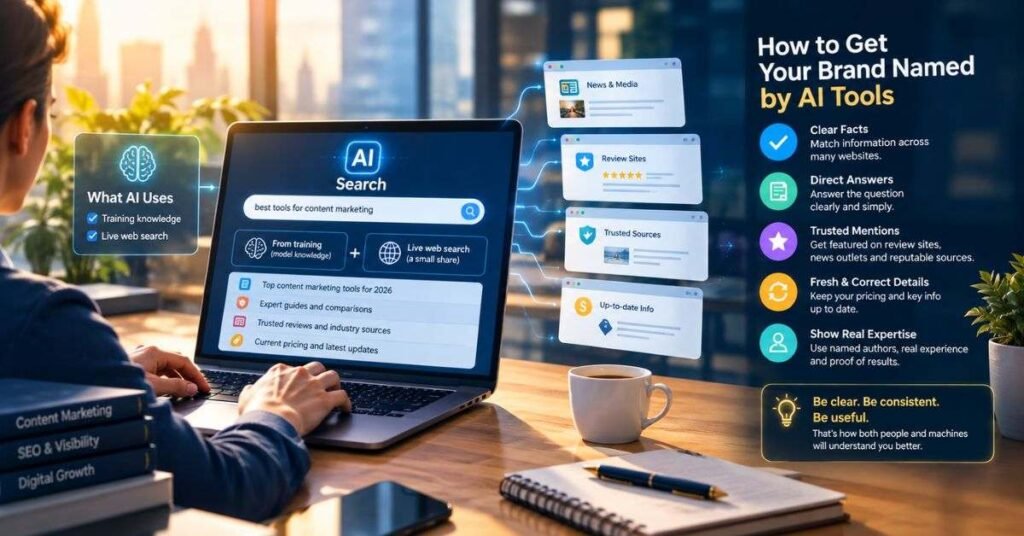
AI tools build answers in two ways. First, they use what they learned in training. Second, for some questions, they search the web live and read a few pages. One 2026 study from the B2B firm Demand-Genius suggests live searching happens only a small share of the time, and early research questions lean mostly on what the model already knows. Treat that as one study, not a final rule.
Either way, a few things help a brand get named:
- Clear facts that match across many websites
- Pages that answer a question directly
- Mentions from trusted sources, such as review sites and news outlets
- Fresh, correct details, such as current pricing
AI tools also look for signs of real expertise, like named authors, real experience, and proof. This matches Google’s long-time advice to create helpful, people-first content, which you can read in its helpful content guidance.
The lesson is simple: be clear, be consistent, and be useful. Do that, and both people and machines will understand you better.
Build Content That AI Can Quote
AI tools like content that is easy to lift into an answer. Here is how to write it:
- Put the answer first. Start each section with a one- or two-sentence answer, then explain.
- Use clear headings. Write them as questions people really ask.
- Keep paragraphs short. Two to four sentences works well.
- Add lists and tables. They make facts easy to spot.
- Share something new. Original data, real examples, and your own lessons give AI a reason to cite you.
- Show who wrote it. Add author names and short bios.
Step five matters most. AI has already read thousands of articles that repeat the same tips. If your page says the same thing, it blends in. Share a survey, a customer result, or a lesson from your own work instead.
Do not publish hundreds of thin, AI-written pages. Ten strong pages beat a thousand weak ones. For help planning pages around buyer questions, see our B2B content marketing guide.
Strengthen Your Brand Across the Web
Your own website is only one voice. AI also reads what others say about you. If review sites, news stories, and forum posts describe you well, AI is more likely to do the same.
Focus on places your buyers already trust:
- Review platforms in your category, such as G2 or Capterra
- Industry news sites and podcasts
- LinkedIn posts from real experts at your company
- Community sites where buyers ask questions
- Partner and customer pages
Keep your story the same everywhere. If your homepage says you serve banks, but a review site says you serve schools, AI may get confused and skip you. Use the same company name, product names, and short description on every page and profile.
Also ask happy customers for honest reviews, and never buy fake ones. The U.S. Federal Trade Commission has rules against fake reviews and misleading endorsements, and its business guidance explains how to stay honest. Real proof builds trust with people and with AI.
Fix the Technical Basics

If bots cannot reach your pages, nothing else works. AI search leans on the same web that search engines use, so classic SEO still matters. Check these basics:
- Robots.txt: Make sure you are not blocking bots you want.
- Indexing: Important pages should not carry a “noindex” tag.
- Speed and mobile: Pages should load fast on phones.
- Clean links: Fix broken links and link related pages together.
- Page content: Do not hide key facts in images, pop-ups, or heavy scripts.
- Structured data: Add markup, such as Organization and Article, to help machines read your pages. You can learn the format at Schema.org.
Structured data does not guarantee a mention. It simply removes confusion. Some brands also add a file called llms.txt as a map of their key pages. It is optional, and no one can promise it boosts results.
Fix the basics first, then move on to the fancy ideas. For a full list, read our B2B SEO checklist.
Visual Guide: The Plan and the Scoreboard
The first table shows how ai search optimization services for B2B are usually split into parts. The time ranges are rough estimates, and your results may differ.
The Work and How Long It Takes
| Work Area | Simple Meaning | Example Task | Rough Time to See Effects |
|---|---|---|---|
| Audit | Learn where you stand | Ask 10 buyer questions in 3 AI tools | 1–2 weeks |
| Technical fixes | Let bots read your site | Fix robots.txt, add schema | 1–4 weeks |
| Entity clean-up | Match facts everywhere | Update your company description on all profiles | 2–6 weeks |
| Content work | Make pages easy to quote | Add short answers and tables to 5 key pages | 1–3 months |
| Authority building | Earn outside mentions | Get listed on review sites, publish original research | 3–6+ months |
The Scoreboard
| Metric | What It Tells You | How to Check It |
|---|---|---|
| Share of voice | How often you appear versus rivals | Run the same 20 questions every month |
| Accuracy | Whether AI gets your facts right | Compare answers to your website |
| Tone | Whether the description is positive or negative | Read the answers |
| Cited pages | Which of your pages AI names as sources | Note the links in answers |
| Referral visits | Clicks that come from AI tools | Check your analytics |
| Qualified leads | Demo requests and sales calls | Ask “How did you hear about us?” |
How to Measure Results
Tracking AI search is harder than tracking Google rankings. AI answers change from one run to the next, and the same question can give different brand names. So look for trends, not single results.
Here is a simple method:
- Write 20 questions a buyer would ask, from early research to final choice.
- Ask them in ChatGPT, Gemini, Perplexity, Claude, and Google’s AI Overviews.
- Mark each result as Recommended, Mentioned, or Absent.
- Save the results in a sheet with the date.
- Repeat every month using the same questions.
Share of voice is the key number. Out of all the answers, how often is your brand there compared with rivals? Also check that AI gets your facts right, such as price and features.
Do not judge results by traffic alone. AI tools send fewer clicks than classic search, but the visitors who do arrive may be ready to talk. When a vendor offers ai search optimization services for B2B, ask them to report these same numbers each month and explain the ups and downs.
How Much Do AI Search Optimization Services for B2B Cost, and How Do You Choose a Partner?

Prices vary a lot. One agency, VisibleIQ, says most serious programs for funded B2B software companies fall between about $3,000 and $15,000 per month. Smaller jobs, like a one-time audit or a content clean-up, often cost less. The price depends on how crowded your market is, how big your gaps are, and how well known your brand already is. Always ask for current quotes, because this market is new and prices move fast.
Use this checklist when choosing a partner:
- Do they explain their method in plain words?
- Do they show real examples or case studies?
- Do they build on SEO instead of ignoring it?
- Do they refuse to guarantee a specific AI answer? Honest providers do.
- Do they report on leads and revenue, not just mentions?
- Do they admit what is still unknown?
Be careful with anyone who promises first place in ChatGPT. No one controls what an AI says on a given day. A good partner sets goals you can check.
Common Mistakes to Avoid
Many teams lose time by repeating the same errors. Watch out for these:
- Copying old SEO habits without changes. AI answers questions in full sentences, so write for real questions, not just short keywords.
- Stuffing keywords. Repeating a phrase again and again hurts readers and does not build trust.
- Publishing pages in bulk. Thin pages add noise, not authority.
- Ignoring third-party sites. Your reviews and outside mentions shape the answers.
- Testing only one AI tool. Buyers use many tools, and each one pulls from different sources.
- Buying ai search optimization services for B2B because of a pretty dashboard. Dashboards show what happened, not what to do next. Ask what actions will follow.
- Expecting results overnight. Fixing a wrong fact can work in days, but trust usually builds over months.
- Making claims you cannot prove. Honest content wins more trust over time.
FAQs
What is AI search optimization
It is the work of helping AI tools find, understand, trust, and mention your brand in their answers.
Is it the same as SEO
No, but SEO is the foundation. AI search adds work on brand facts, outside mentions, and answer-ready content.
How long does it take to see results
Small fixes can show up in days or weeks. Stronger authority and lead growth often take three to six months or more.
Can anyone guarantee a mention in ChatGPT
No. AI answers change by question, user, and day, so be wary of any guarantee.
Do small B2B companies need it
Yes, if your buyers use AI to research. Start small with a simple audit and a few strong pages.
Conclusion
AI tools are now part of how business buyers learn, compare, and choose. If your brand is missing from their answers, rivals may win trust before you join the conversation. The good news is that you can start today.
Remember the main steps. Check what AI says about you. Fix your facts and technical basics. Write clear, useful pages with real examples. Earn honest mentions across the web. Track progress each month with the same set of questions.
If you plan to hire help, choose ai search optimization services for B2B that explain their method plainly, report on real business results, and never promise the impossible. Whether you work with a partner or do it yourself, start small this week. Pick ten buyer questions, test them in two or three AI tools, and write down what you see. That one step will show you where you stand.