
Solar power has become one of the smartest ways for homes and businesses to cut electricity bills, especially in countries like Pakistan where power prices keep rising. Among the many brands on the market today, one name that keeps popping up in searches is the Aikko solar stellar panel (a common spelling of the Aiko brand, also written as “Aiko” by the manufacturer). If you have seen this term while researching solar panels and wondered what it actually means, you are in the right place.
This guide breaks everything down in plain, easy words — no confusing technical jargon. We will look at how this panel works, how much power it produces, how long it lasts, what it costs in 2026, and whether it is a smart choice for your roof. By the end, you will know exactly what to ask your installer and how to decide if this panel fits your home or business.
What Is an Aikko Solar Stellar Panel
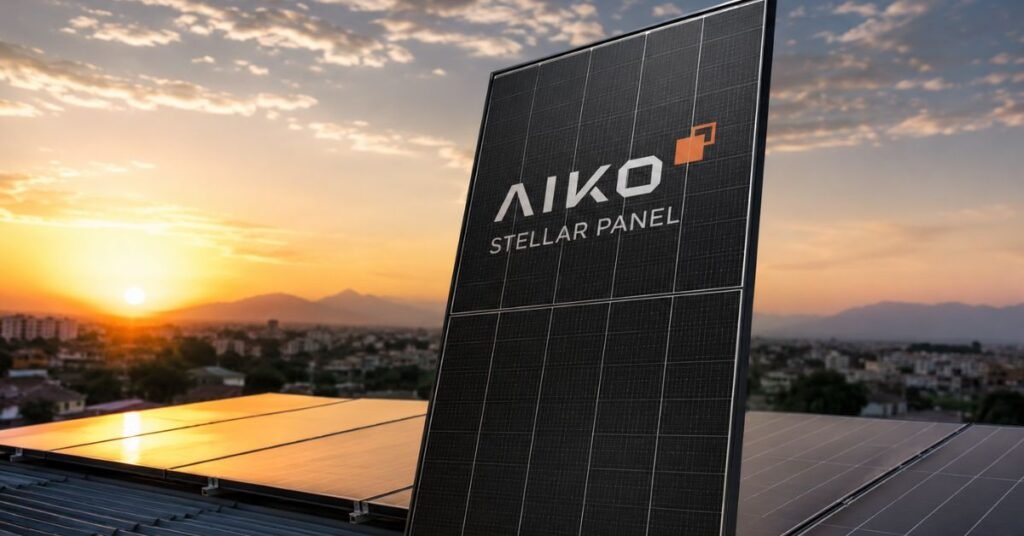
The term Aikko solar stellar panel refers to solar modules made by Aiko Solar, a Chinese solar manufacturer known for a special cell design called ABC, short for “All Back Contact.” Most people searching for this term are simply looking for information on Aiko’s panels, sometimes typing the brand name slightly differently.
So what makes this panel different from a normal solar panel? On a typical panel, thin silver lines called busbars run across the front of each cell. These lines carry electricity, but they also block a small amount of sunlight from reaching the cell. Aiko flipped this design around. In its ABC panels, all the electrical wiring sits on the back of the cell instead of the front. This means the entire front surface is free to soak up sunlight, with nothing blocking the light.
The result is a panel that looks cleaner (no visible lines), performs better in weak or cloudy light, and often produces more electricity from the same size of roof. Aiko first launched this technology in 2022 and has since become one of the most talked-about names in the high-efficiency solar panel space, shipping to dozens of countries around the world.
In simple words: it is a premium, high-performance solar panel built with rear-contact cell technology, designed for homeowners who want maximum power from limited roof space.
The Technology Behind It: N-Type ABC Cells Explained
To understand why this panel performs so well, it helps to know a little about the science — explained simply.
Most solar cells today are made from silicon, a material that turns sunlight into electricity. There are two common types: P-type and N-type. N-type silicon is considered better quality because it loses power more slowly over time and handles heat more gracefully. Aiko uses N-type silicon as the base for its cells.
On top of that, Aiko applies its “All Back Contact” design. Picture a solar cell as a sheet of paper. On a normal panel, wires are taped across the front, covering part of it. On an ABC cell, those wires move to the back, leaving the whole front clear for sunlight.
This combination of N-type silicon and back-contact wiring gives three real benefits:
- More sunlight capture, because nothing blocks the front surface
- Better performance in cloudy or low-light conditions, useful during Pakistan’s monsoon season
- A cleaner, all-black appearance, popular for homes that care about looks
Aiko also uses a technology called zero-busbar design in its newer modules, along with copper interconnects that resist cracking better than older silver-paste wiring. Together, these upgrades explain why the brand has become one of the fastest-growing names in rooftop solar.
Efficiency and Power Output in 2026
Efficiency is simply how much of the sunlight hitting a panel actually turns into usable electricity. A higher efficiency number means more power from the same panel size — which matters a lot if your roof space is limited.
By 2026, Aiko’s mass-produced modules are reaching module efficiency above 25%, with some flagship models hitting as high as 25.6% in commercial production and record lab results even higher. For comparison, older standard panels usually sit between 18% and 21% efficiency.
In real terms, this means a homeowner can install fewer panels and still get the same total power output, which helps on smaller rooftops common in urban Pakistani homes. Current residential models range from around 635 watts up to 770 watts, with larger bifacial (double-sided) versions available for commercial rooftops and solar farms. Bifacial panels also capture reflected sunlight on their back side, adding extra output on light-coloured or elevated mounting surfaces.
For anyone comparing options, efficiency is one of the clearest ways to judge value — a higher number simply means more electricity from the same sunlight.
Temperature Performance: Why It Matters in Pakistan
Pakistan’s summers are extreme. Rooftop temperatures in cities like Multan, Hyderabad, and Lahore can climb well above 60°C between June and August. This matters more than most people realise, because solar panels actually lose efficiency as they get hotter — even though they need sunlight to work.
This drop-off is measured using something called the “temperature coefficient.” A standard panel might lose around 0.40–0.45% of its output for every degree Celsius above 25°C. Over a scorching Pakistani afternoon, that adds up to a real loss in daily power generation.
Panels built on N-type ABC technology typically have a lower temperature coefficient, often around −0.26% to −0.29% per degree. In plain terms, they lose less power as the heat rises, which means more consistent output during the hottest, sunniest months — exactly when air conditioners are running hardest and electricity bills matter most.
This is one of the strongest practical reasons Pakistani buyers are showing interest in this panel type — it is not just about efficiency on a mild spring day, but about how the panel behaves during a 45°C July afternoon, which is when your system works hardest to save you money.
Degradation Rate and Long-Term Reliability
Every solar panel loses a small amount of power each year — this is called degradation. It is completely normal and expected. What matters is how slowly that decline happens, because a slower rate means more electricity generated over 25 to 30 years.
Standard panels often degrade around 2% in the first year and then roughly 0.5% every year after that. Aiko’s ABC panels are typically rated for about 1% degradation in year one, dropping to around 0.4% or less per year afterward. By year 30, many models are still guaranteed to produce over 87% of their original rated power.
In everyday terms, this slower decline can add up to thousands of extra kilowatt-hours over the system’s life, at no extra cost after installation. Reliability also comes down to build quality: because the wiring sits on the back, the front glass has fewer metal parts exposed to weather, dust, and corrosion — a small but meaningful advantage in Pakistan’s dusty, humid conditions. For anyone planning a long-term rooftop investment, degradation rate matters just as much as the starting efficiency number.
Visual Snapshot: Specs and Price Comparison (2026)
Here is a simple side-by-side look at how the Aikko solar stellar panel compares with common alternatives, based on the latest 2026 market data.
Aiko ABC Panel Specifications (2026 Residential Range)
| Model / Wattage | Cell Type | Module Efficiency | Temperature Coefficient | Product Warranty |
|---|---|---|---|---|
| 635W – 665W Series | N-Type ABC | 23.6% – 24.6% | −0.26%/°C | 25 years |
| 690W Infinite Ultra | N-Type ABC (Gen 4) | Up to 25.6% | −0.26%/°C | 25 years |
| 770W Bifacial | N-Type ABC Bifacial | ~24% (plus rear gain) | −0.29%/°C | 25 years |
Panel Technology Comparison
| Feature | Standard P-Type Panel | TOPCon N-Type Panel | Aiko ABC Panel |
|---|---|---|---|
| Typical Efficiency | 18% – 21% | 22% – 23.5% | 23.6% – 25.6% |
| First-Year Degradation | ~2.0% | ~1.0% | ~1.0% |
| Yearly Degradation After | ~0.50% | ~0.40% | ~0.35% – 0.40% |
| Front Surface | Visible busbars | Visible busbars | Clean, no front lines |
| Typical Price (Pakistan, 2026) | Rs. 27 – 35/watt | Rs. 28 – 44/watt | Rs. 33 – 44/watt |
These numbers give a quick, honest picture: this panel type costs a little more per watt, but it produces more electricity, handles heat better, and loses less power over time — which often balances out the extra upfront cost.
Price in Pakistan (2026)
As of mid-2026, the market price for this panel type in Pakistan generally ranges between Rs. 33 and Rs. 44 per watt, depending on the exact model, wattage, city, and current stock levels. The Aikko solar stellar panel price tends to sit slightly above standard TOPCon panels but is often competitive with, or even cheaper than, other back-contact brands from Europe or the United States.
Larger wattage panels, such as the 690W or 770W bifacial versions, usually offer a slightly better price per watt because fewer panels and less mounting hardware are needed to reach the same system size. This can help offset the higher per-watt cost with savings on installation labour and structure.
Prices in Pakistan’s solar market change often due to currency exchange rates, import duties, and shipping costs, so it is always smart to confirm the current rate with a licensed local dealer before buying. Comparing quotes from two or three trusted suppliers is a simple way to avoid overpaying.
Warranty and After-Sales Support
A solar panel is a long-term investment, so warranty terms matter as much as the specification sheet. Aiko typically offers a 25-year product warranty, covering manufacturing defects, along with a 30-year performance warranty guaranteeing a minimum power output level over that period.
This places the brand firmly in what the industry calls “Tier-1” territory — a classification given to manufacturers with strong financial backing, large-scale production, and a track record of honouring warranty claims.
In Pakistan, after-sales support is usually handled through authorised local distributors rather than the manufacturer directly. Before buying, it is worth asking your installer these simple questions:
- Is the seller an authorised Aiko distributor?
- Will warranty claims be processed locally, or do they require contacting the company overseas?
- Is proof of purchase and serial number registration provided?
Buying from a verified, authorised dealer protects your warranty rights and makes any future claims much easier to process.
How It Compares to Other Solar Brands
Pakistan’s solar market includes several strong Tier-1 brands, such as Longi, Jinko, and Canadian Solar. Longi, in particular, makes a similar back-contact panel called HPBC, which competes closely with Aiko’s ABC design in both efficiency and price.
The main differences buyers should know:
- Local availability: Longi has a wider distribution network due to its longer presence in Pakistan, while Aiko is newer but expanding quickly.
- Price positioning: Aiko is often priced slightly lower than equivalent Longi or SunPower back-contact models, with comparable or better efficiency.
- Technology maturity: HPBC and ABC represent the same core idea — moving wiring to the rear of the cell — built using different manufacturing methods.
For buyers focused purely on price, standard TOPCon panels remain a solid budget option. For anyone with limited roof space who wants maximum watts, back-contact options like this are worth the small premium.
Installation Tips and What to Check Before Buying
Getting the most out of any solar panel depends heavily on correct installation. Here are simple, practical tips before you commit:
Check the roof orientation. South-facing roofs (in Pakistan) generally receive the most consistent sunlight throughout the day.
Confirm the inverter compatibility. Higher-wattage panels need inverters rated to handle their output safely.
Ask about mounting structure quality. A weak or rusted structure can shorten the life of even the best panel.
Verify net billing registration. Pakistan shifted from net metering to a net billing system in 2026, so ask your installer how this affects your savings calculation.
Request a written quote listing panel model, wattage, warranty terms, and installation cost separately.
A high-efficiency panel only performs at its best when paired with a properly sized system and correct installation. Choosing a licensed, experienced installer matters just as much as choosing the right panel brand.
Is It Worth the Investment? Pros and Cons

Every solar decision comes down to balancing upfront cost against long-term savings. Here is a simple, honest breakdown.
Advantages:
- Higher efficiency means fewer panels needed for the same power output
- Better heat performance, useful for Pakistan’s hot summers
- Slower degradation, meaning more electricity produced over 25–30 years
- Clean, front-line-free appearance
- Strong 25-year product and 30-year performance warranty
Trade-offs:
- Slightly higher price per watt compared to standard panels
- Newer to the Pakistani market, so local stock and support may vary by city
- Full savings benefit depends on correct system sizing and installation
For homeowners with plenty of roof space and a tight budget, a standard TOPCon panel may still make more financial sense. But for anyone with limited rooftop area, high electricity usage, or a preference for maximum long-term output, the extra investment often pays off within the panel’s lifetime.
Frequently Asked Questions
Is the Aikko solar stellar panel good for Pakistani homes
Yes — its strong heat tolerance and high efficiency make it well suited to Pakistan’s hot climate and smaller urban rooftops.
How long does this panel last
It typically carries a 25-year product warranty and a 30-year performance warranty, with most units still working well beyond that.
Is it more expensive than regular solar panels
Slightly, yes — expect a modest price premium over standard TOPCon or P-type panels, offset by higher output and slower degradation.
Does it work well in cloudy or low-light conditions
Yes, its cell design captures more usable light even on overcast days, which helps during Pakistan’s monsoon season.
Where can I buy genuine panels in Pakistan
Always buy through an authorised local distributor to ensure genuine stock and valid warranty coverage.
Conclusion
Choosing the right solar panel is one of the most important decisions you will make for your home or business energy setup, and understanding your options in simple terms makes that decision much easier. The panel commonly searched as the Aikko solar stellar panel stands out in 2026 for its high efficiency, strong heat performance, and slow power loss over time — all of which matter a great deal in Pakistan’s climate and rising electricity costs.
While it does carry a slightly higher price tag than basic panels, the long-term savings from better performance and durability often make up the difference, especially for homes with limited roof space or high energy needs.
Before making a final decision, get quotes from two or three licensed local installers, confirm current pricing, and check that you are buying from an authorised dealer. If you are ready to move forward, talk to a trusted solar installer near you, compare system sizes for your home, and take the first step toward lower electricity bills and cleaner energy today.