

By the editorial olivia wilson | Reviewed for 2026
Software that people pay for every month is one of the most popular things to buy and sell online today. Maybe you want to own a company that earns money while you sleep. Maybe you built an app and now want to cash out. Either way, you need clear and honest help.
If you are searching for a SaaS business for sale, you will see many listings, big numbers, and fancy words. It is easy to feel lost. This guide explains everything in plain English, so even a beginner can follow it.
You will learn what SaaS means, how prices work, where to look, and how to check a company before you pay. You will also see simple tables, a list of warning signs, and quick answers to common questions. Sellers will find tips to earn a better price.
The advice here is based on public marketplace data, government guidance, and the common steps used in real deals in 2026. Small mistakes can cost a lot of money, so take your time and use this page as your checklist.
What SaaS Means and Why Buyers Love It
SaaS stands for software as a service. Customers do not buy the software one time. They pay a monthly or yearly fee to use it on the internet. Think of project tools, billing apps, or online design tools.
This model is popular for three reasons. First, the income repeats. If 100 customers pay $50 each month, the owner can expect about $5,000 before the month even starts. Second, the product can grow without much extra cost. Adding one more customer rarely means building a new factory or filling a warehouse. Third, many owners can work from anywhere, because the whole company lives online.
Buying also beats starting from zero. A ready company already has code, customers, and an income history. You skip the scary first years, when many new startups fail. Still, risk does not vanish. Customers can cancel, tools can break, and rivals can copy features.
That is why smart buyers look at more than the price tag. They study how long customers stay, how the company finds new users, and whether the work depends on one person. A SaaS business for sale with clean records and happy customers is far safer than one with messy books.
How Much Does a Software Subscription Company Cost in 2026
Price depends on size, growth, and profit. There is no single formula, but most deals use one of two methods.
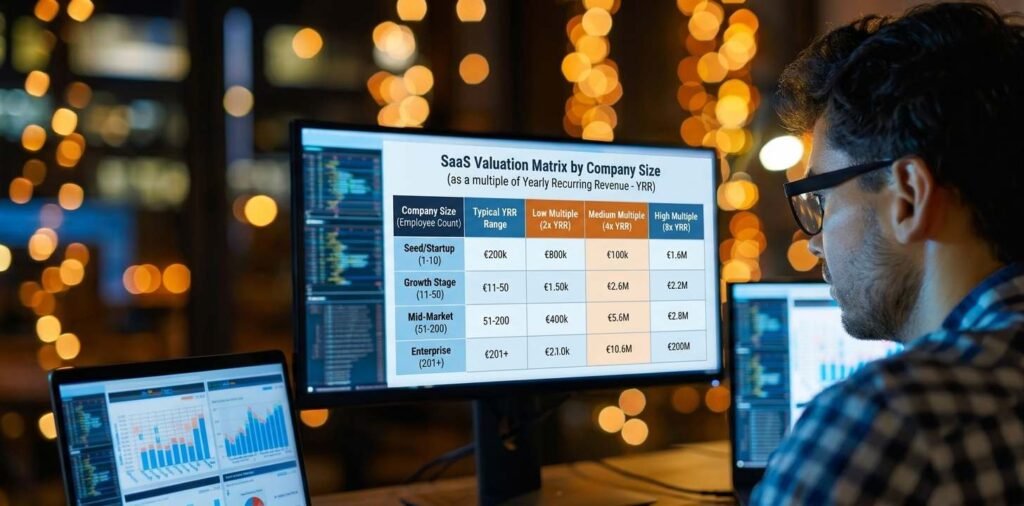
Revenue multiple. Take the yearly recurring revenue, called ARR, and multiply it. Market guides in 2026 show that small companies under $1 million in ARR often sell for about 2 to 4 times ARR. Companies between $1 million and $5 million often sell for 3 to 6 times ARR. Larger and faster-growing firms can go higher.
Profit multiple. Very small, owner-run companies are often priced on seller’s discretionary earnings, or SDE. SDE is the owner’s profit plus their pay and one-time costs. The multiple is commonly 3 to 5 times yearly SDE.
Many things move the price up or down. These include growth speed, how many customers cancel, profit margin, and how much one big customer matters. A company that grows fast and keeps its customers earns a higher multiple. A company that keeps losing customers earns a lower one.
Do not trust a quick online guess. Try a free SaaS valuation tool, compare similar sales, and ask a professional to check the numbers. When you see an asking price on a SaaS business for sale, always ask how the seller reached it.
Where to Find Software Companies for Sale
You have four main paths, and each one fits a different buyer.
Online marketplaces. Sites such as Acquire.com, Quiet Light, Empire Flippers, and Flippa list many companies. Acquire.com says it has more than 500,000 members, and its listings often include connected tools like Stripe or Google Analytics, so you can check the numbers yourself. Quiet Light lists deals from about $200,000 to several million dollars.
Business brokers. A broker finds deals, checks the price, and guides you through the paperwork. This helps most on larger deals.
Direct outreach. Write to founders of tools you like and ask if they would ever sell. Many owners never list their company, but they will talk.
Your own network. Friends, past coworkers, and industry groups often hear about deals early.
Whichever path you pick, set up email alerts and use filters for monthly revenue, churn, tech stack, and how many hours the owner works. When you search for a SaaS business for sale, save every listing that looks good, then compare them side by side. Do not rush. Good deals appear all the time.
The Key Numbers Every Buyer Should Check
Numbers tell the true story of a software company. Ask for at least 24 months of records, and learn these terms first.
MRR and ARR. Monthly recurring revenue (MRR) is the steady money earned each month from subscriptions. Multiply it by 12 to get annual recurring revenue (ARR). Do not count one-time fees.
Churn. Churn is the share of customers, or money, lost over time. High churn means people try the tool and leave. For products with small customers, losing more than 15% of customers in a year is a warning sign.
Net revenue retention (NRR). This shows whether current customers spend more or less over time. Above 100% is great, because the company grows even without new sales.
Gross margin. This is revenue minus the direct cost to run the product, such as hosting and support. Healthy software often lands between 70% and 85%.
LTV to CAC. Lifetime value (LTV) is what a customer pays during their stay. Customer acquisition cost (CAC) is what you spend to win them. A ratio of 3 to 1 or better is a healthy goal.
Customer concentration. If one client pays a big share of all revenue, losing them could hurt badly. Many experts prefer that no single customer be above 15% to 20% of ARR.
Use these numbers together. One good number can hide a weak one.
Visual Guide: Prices and Health Checks at a Glance
These tables turn the big ideas into quick facts. The numbers are common ranges from 2026 market guides. Real deals can be higher or lower.
Common price ranges by company size
| Yearly recurring revenue (ARR) | Typical price | Who often buys |
|---|---|---|
| Under $1 million | 2x to 4x ARR | Solo buyers and small groups |
| $1 million to $5 million | 3x to 6x ARR | Experienced operators and small funds |
| $5 million to $20 million | 5x to 8x ARR | Private equity and larger software firms |
Health check for any company you review
| Number | Good sign | Warning sign |
|---|---|---|
| Yearly customer churn (small customers) | Below 10% | Above 15% |
| Net revenue retention | Above 100% | Below 100% |
| Gross margin | 70% to 85% | Below 60% |
| LTV to CAC ratio | 3 to 1 or better | Close to 1 to 1 |
| Biggest customer’s share of ARR | Under 15% | Above 30% |
How long a deal usually takes
| Deal type | Typical time |
|---|---|
| Small marketplace deal | 60 to 120 days |
| Mid-size deal with an advisor | 9 to 12 months |
How to Check a Company Step by Step
Good buyers follow a clear process. This is called due diligence, which simply means checking the facts before you pay. Quiet Light teaches four pillars of value: growth, risk, easy transfer, and good records. Keep them in mind as you work. For a deeper list, see our due diligence checklist.
- Sign an NDA. This is a privacy agreement that lets the seller share private details.
- Ask for 24 months of records. Request profit and loss reports, bank records, and a month-by-month revenue report.
- Match the money. Compare the seller’s numbers with Stripe, PayPal, or bank deposits.
- Study the customers. Look at how long they stay, how they found the product, and who pays the most.
- Review the code and tools. Confirm the company owns its code, and that any freelancers signed papers giving the company full rights.
- Test safety and privacy. Ask how data is stored and protected. The NIST Cybersecurity Framework at nist.gov is a trusted guide, and the Federal Trade Commission shares rules on protecting customer data.
- Check taxes. Make sure the company collected sales tax or VAT where required.
- Talk to the owner. Ask why they are selling and how many hours they work each week.
Red Flags That Should Make You Walk Away

Spotting a weak SaaS business for sale early can save you thousands of dollars. Watch for these warning signs.
- Revenue that does not match bank records. Honest numbers should line up.
- One customer or one channel pays for everything. If that source fails, the whole company is at risk.
- Rising churn. If more people leave each month, the product may be losing its value.
- Messy books. If a seller cannot show clean records, the real profit is unclear.
- Unclear code ownership. Without proof, a freelancer could later claim rights to the product.
- Everything depends on the owner. If only the founder knows how things work, the company is hard to hand over.
- No plan for AI. In 2026, buyers expect an answer to how AI could help or hurt the product.
- Pressure to hurry. A seller who rushes you may be hiding something.
One red flag does not always mean a bad deal. Some problems can be fixed or reflected in a lower price. But several flags together are a clear sign to stop and look elsewhere.
How to Pay: Loans, Cash, and Deal Terms
Most buyers do not pay all cash on day one. Here are the common ways to pay.
Cash. Simple and fast, and sellers often like it best.
Bank or SBA loans. In the United States, the U.S. Small Business Administration backs 7(a) loans that can help people buy an existing business. Some marketplace listings are marked as SBA pre-qualified.
Seller financing. The seller lets you pay part of the price over time. It can also show that the seller believes in the company.
Earnouts. Part of the price is paid later, only if the company hits agreed goals. Write the goals clearly, so no one argues later.
Escrow. A neutral third party holds the money until both sides finish their duties. This protects you and the seller.
Also learn the difference between an asset sale and a share sale. In an asset sale, you buy the parts of the company, such as code and customers. In a share sale, you buy the whole company, including its past debts. The choice changes taxes for both sides, so speak with a tax advisor and a lawyer before you sign anything.
Tips for Sellers: How to Get a Better Price
If you are the one selling, preparation is your best tool. Most buyers pay more when the company looks clean, safe, and easy to take over.
Start at least 6 to 12 months early. Keep clear monthly records, and separate personal costs from business costs. Show a month-by-month chart of new, lost, and growing revenue. Write down how the company runs, from customer support to software updates, so a new owner can step in fast.
Fix easy problems first. Make sure the company owns its code. Reduce your dependence on one big customer. Show steady or falling churn. If you can, hire or train someone who can handle daily tasks without you.
Then invite many buyers, not just one. Marketplaces such as Acquire.com say a typical listing there gets about 10 offers, and competition can lift both price and terms. Also avoid giving one buyer exclusive time too early, because that removes your power to compare offers.
Finally, plan your taxes before the deal, not after. For a full walk-through, read our guide on how to sell a software company.
What Changes After You Buy: Your First 90 Days

The deal is not the finish line. The first 90 days decide whether your purchase becomes a success.
Days 1 to 30: Learn and protect. Move all passwords, domains, and accounts into your control. Meet the team and key customers. Keep changes small, because customers like steady service. Ask the seller to stay and help during the handover, which often lasts 3 to 12 months.
Days 31 to 60: Find easy wins. Read customer reviews and support tickets. Fix common bugs. Look at your pricing, and test small changes. Add simple emails that help new users get started.
Days 61 to 90: Plan growth. Pick one or two growth channels, such as search, partnerships, or new features customers keep asking for. Set clear goals for revenue, churn, and support time.
Track the same key numbers every month, so you can spot trouble early. Be kind and open with your customers. Tell them who you are and how to reach you. Trust is your most valuable asset in a business that depends on monthly payments.
Frequently Asked Questions
How much does a SaaS company sell for
Most sell for a multiple of yearly revenue or profit, often 2x to 8x ARR depending on size and growth.
Is buying a SaaS business for sale risky
Yes, like any purchase, but careful checks of revenue, churn, and code ownership can lower the risk a lot.
How long does it take to buy one
Small marketplace deals often close in 60 to 120 days, while larger deals can take 9 to 12 months.
What is a good churn rate
Lower is better. For small-customer products, losing under 10% of customers a year is strong, and over 15% is a warning.
Do I need to know how to code
No, but you should hire or keep someone who can manage the code and fix problems fast.
Conclusion
Buying or selling software is one of the smartest ways to build income that repeats every month. It is not magic, though. The best results come from careful steps: learn the basic numbers, use trusted sources, check every claim, and plan your payment and taxes.
Buyers should look for strong retention, healthy margins, clean records, and a company that can run without one person. Sellers should clean up their books, reduce risk, and invite many buyers. Whichever side you are on, patience pays.
If you are ready to start, take one action today. Write down your budget and your goals, then browse a few trusted marketplaces. Save three companies that fit your plan and run the health checks from this guide. When you find a strong SaaS business for sale, bring in a lawyer and an accountant before you sign.
Have questions or need a second opinion on a deal? Contact our team today, and we will help you take the next step with confidence.