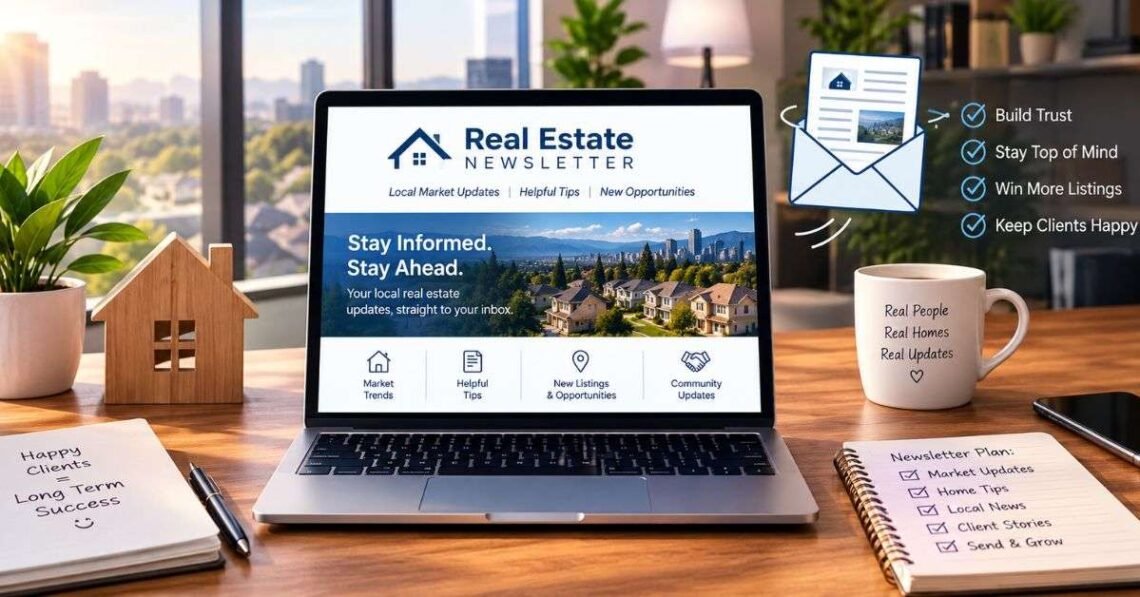
Staying in touch with past clients and future buyers used to mean cold calls and postcards nobody read. Today, one of the simplest and cheapest ways to stay on people’s minds is through Real Estate Newsletters. A good property email doesn’t feel like an ad. It feels like a helpful update from someone who knows the local market and genuinely wants to help.
If you’re an agent, broker, or property manager wondering whether email updates are still worth your time in 2026, the short answer is yes. With inboxes full of AI-written spam, a warm, honest, and useful message stands out more than ever. People still open emails from someone they trust, especially when that email gives them real value instead of just another listing pitch.
This guide walks you through everything you need to know — what to send, how often to send it, which tools to use, and how to avoid the mistakes that make people hit “unsubscribe.” Everything here is written in plain, simple language, so whether you’re new to email marketing or have been sending updates for years, you’ll walk away with a clear plan you can start using today.
What Are Real Estate Newsletters and Why They Still Work in 2026
A property email update is simply a regular message sent to your list of clients, leads, and past customers. It might include new listings, market trends, home tips, or local news. The goal is not to sell in every single email. The goal is to stay useful and stay visible.
Real Estate Newsletters work because buying or selling a home is not a one-time event in someone’s mind — it takes months of thinking, saving, and planning. During that time, most people are not ready to talk to an agent yet. A newsletter keeps you present without being pushy. When they are finally ready, you are the person they already trust, because you’ve been showing up in their inbox with helpful, no-pressure information for months.
This matters even more now. According to the National Association of Realtors‘ 2025 Profile of Home Buyers and Sellers, 88% of home buyers purchased through a real estate agent or broker, and 92% of them were satisfied with their agent’s service. People still want a human guide. A steady email habit is one of the easiest ways to become that trusted guide before the client even picks up the phone.
Why Every Agent and Broker Needs a Newsletter Strategy
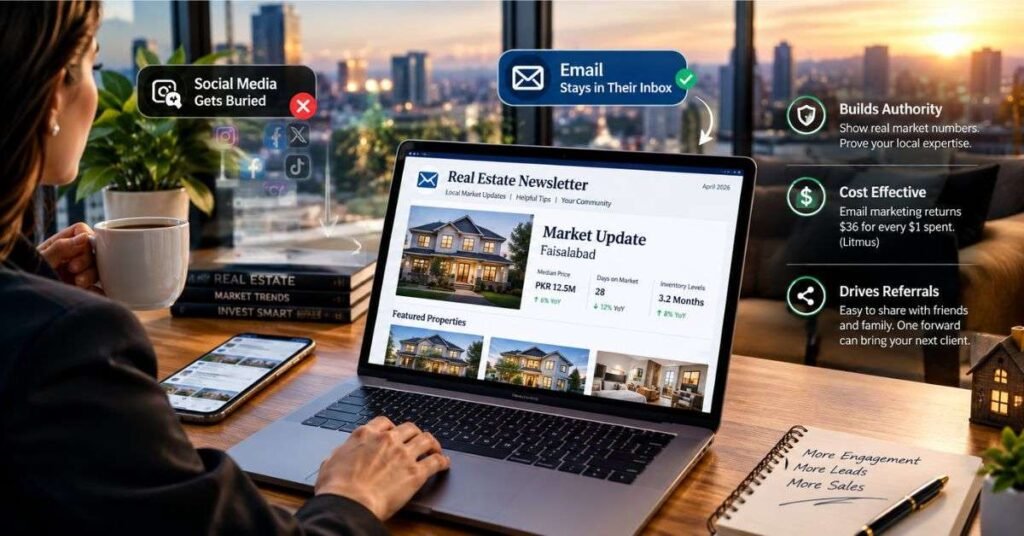
Some agents skip email because they think social media is enough. But social posts get buried in an endless feed within hours. An email sits in someone’s inbox until they read it, and you own that list — no algorithm can take it away from you.
A newsletter also builds authority. When you send a monthly market update with real numbers — median prices, days on market, inventory levels — you show people you understand the local area better than a random listings website. That is a form of expertise readers can feel, even if they never say it out loud.
There’s also a cost angle. Paid ads get more expensive every year, and the results disappear the moment you stop paying. Email is different. You build the list once, and it keeps paying you back. Industry research from Litmus found that email marketing returns roughly $36 for every $1 spent, making it one of the most cost-efficient channels available to small businesses, including real estate teams.
Finally, referrals love forwarding. A well-written property update is easy to share with a friend who’s thinking about moving. That single forward can turn into your next client without you spending a cent on advertising.
How to Build a Quality Subscriber List
Your list is the foundation of everything. A perfectly written email means nothing if it goes to the wrong people or an empty inbox. Here’s how to grow a list that actually converts:
- Start with your own contacts. Past clients, current leads, and your personal network are the easiest people to add — they already know you.
- Add a signup form to your website. Skip generic phrases like “Join my list.” Instead, tell people exactly what they’ll get, such as “Get monthly market updates and new listings before they hit Zillow.”
- Offer something useful in exchange. A free home value estimate, a moving checklist, or a first-time buyer guide gives people a reason to hand over their email address.
- Always get permission first. Never add people without their consent. Not only is this a trust issue, it’s also a legal one, which we’ll cover later.
- Segment as you go. Separate buyers from sellers, and past clients from new leads. This one step makes every future email more relevant and more likely to get opened.
A smaller list of people who actually want to hear from you will always beat a huge list of uninterested contacts.
What to Include: Content Ideas That Keep People Reading

The biggest struggle most agents face isn’t whether to send an email — it’s figuring out what to put in it every single time. The trick is to rotate through a handful of reliable topics instead of reinventing the wheel each month.
Some of the best-performing content ideas for Real Estate Newsletters include:
- Monthly market snapshots — median home prices, average days on market, and how inventory changed in your area
- New and featured listings — a short teaser with one great photo, not a full brochure
- Neighborhood spotlights — highlight a local coffee shop, park, or school district
- Home maintenance tips — seasonal advice like preparing gutters for winter or a spring lawn checklist
- Buyer and seller mistakes to avoid — short, practical lessons from your own experience
- Client success stories — a quick recap of a recent closing (with permission)
- Local events calendar — farmers markets, festivals, and community happenings
You don’t need twenty different ideas. Pick five or six that fit your audience and rotate them through the year. This keeps your workload light while your content stays fresh and worth opening.
Newsletter Frequency and Timing: How Often Should You Send?
Sending too often annoys people. Sending too rarely means they forget who you are. Most successful agents land somewhere between twice a month and once a week, depending on how much genuinely useful content they have to share.
| Sending Frequency | Best For | Risk Level |
|---|---|---|
| Weekly | Busy markets, active buyer/seller lists | Higher risk of fatigue if content is thin |
| Bi-weekly (every 2 weeks) | Most agents and small teams | Balanced, easiest to sustain |
| Monthly | Solo agents, part-time marketers | Lower engagement if too spaced out |
| Quarterly | Long-term nurture lists, cold leads | Risk of being forgotten between sends |
As for timing, data from major email platforms points to mid-morning on Tuesdays through Thursdays as the sweet spot, usually between 9 a.m. and noon. Avoid Mondays, when inboxes are flooded, and weekends, when open rates drop sharply. Whatever schedule you pick, consistency matters more than perfect timing — a predictable rhythm builds trust over time.
Best Tools and Platforms to Send Newsletters
You don’t need expensive software to get started, but the right platform saves hours and improves your results. When choosing a tool for Real Estate Newsletters, look for three things: easy drag-and-drop design, list segmentation, and built-in analytics so you can see what’s working.
| Tool Type | Good For | Typical Monthly Cost |
|---|---|---|
| General email platforms (Mailchimp, Constant Contact) | Beginners, simple designs | Free to $30+ |
| Real estate-specific CRMs (kvCORE, Follow Up Boss) | Agents who want automation + lead tracking | $50–$500+ |
| Design-first tools (Canva, Flodesk) | Visual, template-heavy newsletters | $12–$40 |
If you’re just starting out, don’t overspend on a fancy CRM before you’ve even sent your first ten emails. Start simple, learn what your audience responds to, and upgrade once your list and workflow outgrow the free tools. If you already use property management or CRM software, check whether it has a built-in email feature first — you may not need a separate tool at all.
Writing Style and Design Tips for Higher Open Rates
Nobody wants to read a wall of text from their inbox on a phone screen. Keep sentences short. Use plain, everyday words instead of real estate jargon. If you wouldn’t say it out loud to a client over coffee, don’t write it in the email.
A few practical tips that make a real difference:
- Write subject lines like a person, not a brand. “3 things changed in our market this month” beats “October Newsletter #47.”
- Use one clear photo per section, not a cluttered collage.
- Keep paragraphs to two or three sentences. White space makes emails easier to scan on mobile.
- Add one clear call-to-action, such as “Reply and I’ll send you the numbers for your street” — not five competing buttons.
- Write like you talk. A friendly, conversational tone builds more trust than a formal, corporate voice.
Mobile design matters more than ever, since most people check email on their phone first. Test every email on a small screen before hitting send.
Common Mistakes to Avoid
Even experienced agents fall into a few common traps that quietly hurt their results:
Making every email a sales pitch. If every message pushes a listing, people tune out fast. Aim for value first, sales second.
Ignoring segmentation. Sending the same content to buyers, sellers, and past clients wastes the power of a targeted list.
Skipping the mobile preview. A broken layout on a phone loses readers instantly.
Forgetting the unsubscribe link. This isn’t optional — it’s a legal requirement, and it also builds trust with your audience.
Sending inconsistently. A burst of five emails in one week followed by three months of silence confuses your list and hurts your sender reputation.
Writing overly formal or robotic content. People connect with a real voice, not a corporate brochure.
Avoiding these mistakes alone can dramatically improve how your emails perform, even before you change anything about the content itself.
How to Measure Success (Open Rate, CTR, and ROI)
You can’t improve what you don’t track. Three numbers matter most for Real Estate Newsletters: open rate (how many people opened your email), click-through rate or CTR (how many clicked a link inside it), and replies (how many people engaged directly with you).
A healthy open rate for real estate emails usually sits between 20% and 35%, while a solid click-through rate lands around 2% to 5%. If your numbers are lower, the problem is often the subject line or send time, not the content itself. Test one variable at a time — change only the subject line, or only the send day — so you know exactly what moved the needle.
Don’t obsess over vanity numbers alone. A smaller list with high engagement and real replies is far more valuable than a huge list that ignores you. Track how many leads or referrals come directly from your newsletter over a few months, and you’ll get a much clearer picture of its true return on investment.
Legal Rules and Compliance You Must Know
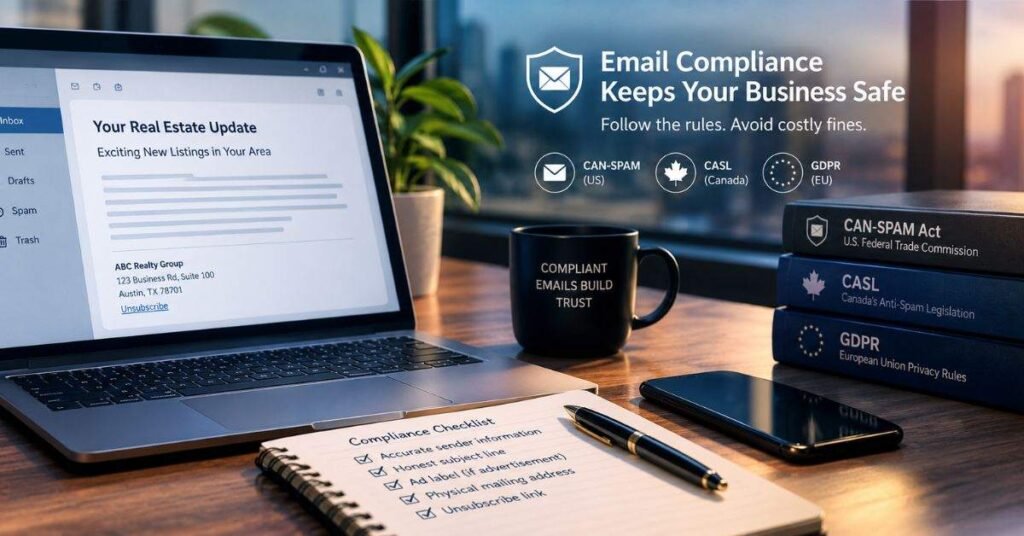
This part isn’t exciting, but it protects you from real penalties. In the United States, every commercial email — including real estate updates — must follow the CAN-SPAM Act. The Federal Trade Commission enforces this law, and it requires accurate sender information, a subject line that reflects the email’s real content, and clear identification if the message is an advertisement. Every email must also include your business’s physical mailing address and an easy way for recipients to unsubscribe.
Failing to follow these rules can lead to steep fines per violation, so it’s worth a quick read of the FTC’s official compliance guide before you send your next campaign. If you serve clients outside the U.S., check local rules too — for example, Canada’s CASL law and the EU’s GDPR have their own consent requirements that are often stricter than CAN-SPAM.
The good news: staying compliant is simple once your system is set up correctly. Most email platforms build the unsubscribe link and sender details in automatically, so this is mostly a one-time setup task, not an ongoing burden.
Frequently Asked Questions
How often should I send real estate newsletters
Most agents find success sending every two weeks to once a month — often enough to stay visible, but not so much that people opt out.
Do real estate newsletters actually generate leads
Yes. They nurture people who aren’t ready to buy or sell yet, so when they are ready, you’re already their trusted contact.
What should the first email to a new subscriber include
A short welcome message, what to expect going forward, and one useful resource, like a local market snapshot or buyer’s checklist.
Is it better to write my own content or use a template
A mix works best — use templates for structure, but write the market commentary and personal notes yourself so it sounds like you.
What’s a good open rate for a real estate email
Between 20% and 35% is considered healthy for this industry; anything higher usually means your subject lines and list quality are strong.
Conclusion
Email is far from dead in 2026 — if anything, it’s become more valuable as inboxes get quieter of true, human communication. Real estate newsletters give you a direct, low-cost way to stay in front of the people who matter most: past clients, warm leads, and everyone in between who isn’t ready to buy or sell just yet. The agents who win aren’t the ones sending the fanciest emails. They’re the ones showing up consistently, with honest, useful content written in a real, human voice.
Start small if you need to. Pick one content idea, choose a simple tool, and commit to a schedule you can actually keep. Over the next few months, watch how many replies, referrals, and closed deals trace back to that one small habit. If you’re ready to put this guide into action, start by drafting your very first email today — your future clients are already waiting in that inbox.