

If you’ve searched for “software name meetshaxs,” you’ve probably noticed something unusual. Different websites describe it in different ways. One page calls it an all-in-one meeting app. Another connects it with software performance optimization. A third uses it in phrases like “improve software meetshaxs,” which reads more like a keyword than a company name. None of the pages we reviewed link to a working product page, a pricing checkout, or a company that can be independently confirmed.
This article takes a different approach than most of what’s currently published on this topic. Rather than filling in the gaps with confident-sounding features, pricing, or reviews, we looked directly at the sources discussing software name meetshaxs, checked what evidence exists, and compared the claims made across several widely shared articles on the subject — including three of the most detailed ones currently online. Where something can’t be confirmed, we say so plainly instead of presenting it as settled fact.
By the end, you’ll understand what this keyword currently is, how the major articles about it differ, how to evaluate any unfamiliar software claim, and what a verifiable collaboration tool looks like by comparison. It’s written in plain, simple language so it’s easy to follow no matter your background.
What People Mean When They Search “Software Name MeetShaxs”
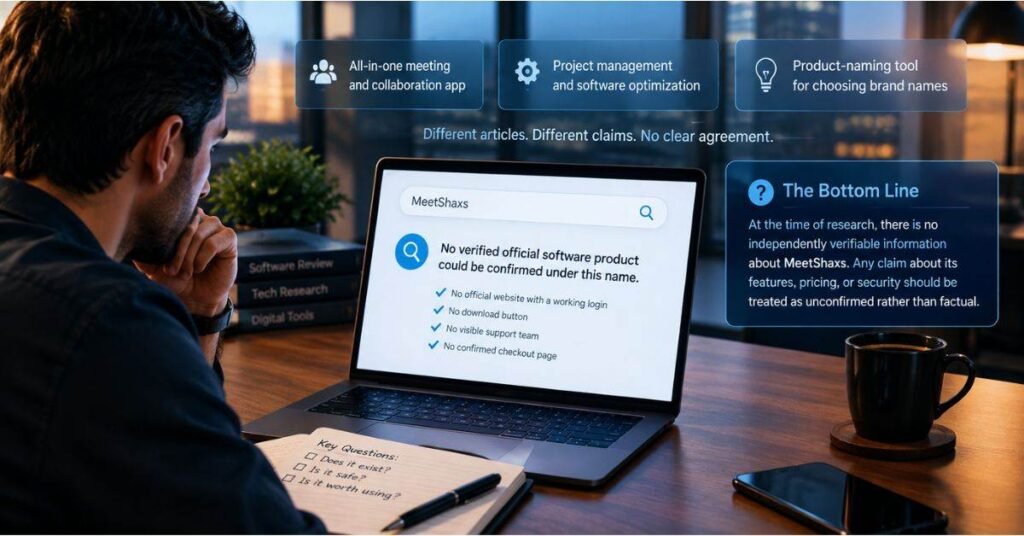
Most people typing this phrase into a search engine want a straightforward answer to one question: does this software exist, and is it worth using? That’s a completely fair thing to want to know.
Based on everything we could check, no official, independently verifiable software product could be confirmed under this name at the time of research. There’s no single official website with a working login, a download button, a visible support team, or a checkout page that multiple independent sources agree on. What exists instead is a cluster of articles that use the phrase in different, sometimes contradictory ways.
Some describe it as an all-in-one meeting and collaboration app. Others connect it with project management, software optimization, or even a “product-naming” tool for choosing brand names. This inconsistency is one of the clearest signals worth paying attention to. When real, established software gets covered by multiple outlets — think Slack, Zoom, or Notion — those articles generally agree on the basics, because they’re describing one confirmed product. That kind of agreement is missing here.
None of this rules out the possibility that a real product could launch under this name later, or that one already exists in a form we simply couldn’t locate through public search. But right now, any specific claim about MeetShaxs’s features, pricing, or security should be treated as unconfirmed rather than factual, since it cannot currently be checked against an authoritative source.
Where the MeetShaxs Name Appears to Come From
Tracing the origin of a search term like this is harder than tracing a normal company, because there’s no press release, funding announcement, or founder interview to point to. What can be observed is the pattern of publication itself.
Articles using this phrase have appeared across a range of blogs and content sites, including general tech and business publications that cover many unrelated topics. Among the pages we were able to check directly, publication dates ranged from around September 2025 to late August 2026 — which suggests this is a relatively recent and still-developing search trend rather than an established, long-running product story.
One notable detail: the domain meetshaxs.com exists and, when checked directly, turns out to be a standard WordPress blog. It has no product page, no signup form, no app to download, and no pricing information. It only contains blog posts discussing MeetShaxs, alongside unrelated posts on general content-writing topics. If this were the homepage of a real software company, the usual pattern would be reversed — a product front and center, with a blog as a secondary section, rather than a blog with no underlying product visible.
This pattern is consistent with what’s sometimes called keyword-driven or programmatic publishing, where content is built around a trending search phrase rather than firsthand use of a real, tested product. That’s an observation based on what we found, not a claim about anyone’s intent.
How the Three Most-Discussed MeetShaxs Articles Compare
To understand how confused the current information landscape really is, it helps to look closely at three widely shared articles on this topic and compare what each one actually claims.
One detailed guide presents MeetShaxs as a fully built, market-ready collaboration platform. It states specific monthly pricing tiers, names security certifications such as SOC 2 Type II and ISO 27001, cites a 4.7-out-of-5 user rating, references speed-benchmark testing from a named lab, and describes case studies with exact savings figures. The claims are presented with a high degree of confidence and specificity. However, none of these details link back to an official MeetShaxs vendor page, a certifying body’s public registry, or an independently published benchmark report — they trace only to other blog-style articles making similar unverified claims about the same subject.
A second widely shared guide takes a noticeably more cautious position. It explicitly acknowledges that different MeetShaxs-branded pages describe different products: one associated with the domain MeetShaxs.net is described as a tool for structuring product-naming meetings (using AI-generated name ideas, domain checks, and team voting), while a page at Meetshaxs.com is described in connection with software performance optimization rather than collaboration. This article repeatedly recommends that readers verify vendor identity, pricing, and security claims before trusting them, and includes checklists for doing so rather than presenting features as confirmed.
A third article frames MeetShaxs as a general collaboration and productivity platform, but includes an explicit pros-and-cons breakdown that lists “limited publicly verified product information,” “unclear pricing details,” “lack of confirmed security documentation,” and “limited independent user reviews” as open concerns, even while describing potential use cases.
Put side by side, these three widely circulated articles do not agree on what MeetShaxs actually is, what it costs, or which features are real. Two of the three explicitly acknowledge this uncertainty within their own text. That level of internal disagreement across some of the most detailed coverage available is itself a meaningful finding — it means no reader can currently treat any single article’s specific claims as confirmed without independent verification.
Is There an Official MeetShaxs Company or App
This is the central question, and the honest answer is that no official, independently verifiable company or app could be confirmed at the time of research.
Among the sources we checked, there’s no confirmed developer, headquarters, executive team, funding history, app store listing, or support channel that traces back to one consistent, operating software company under this name. The domain meetshaxs.com exists, but as noted above, it functions as a content blog rather than a software product’s homepage. Other domains associated with the name describe entirely different kinds of tools.
If you search established, trustworthy software directories or app marketplaces for “MeetShaxs” as a listed product, you won’t currently find a verified entry with a consistent developer name, a real installation history, or independently dated user reviews. That gap matters. Even brand-new, early-stage software usually has at least one of these signals: an app store listing, a company page with named employees, a support email that responds, or coverage from an established tech outlet that isn’t simply repeating the same unverified phrase.
None of this proves bad intent behind the term. It’s possible this started as branding experimentation, a placeholder name, or a test of how search content spreads. But it does mean that, based on what’s currently checkable, nobody should install anything, enter payment details, or treat specific technical claims about MeetShaxs — pricing tiers, certifications, or performance numbers — as confirmed, since they cannot be traced to an authoritative source outside the articles themselves.
Why So Many Articles Describe It Differently
Understanding why this happens is useful well beyond this one search term. When a phrase starts appearing in search data, some websites publish content built around that exact phrase simply because people are searching for it — not necessarily because the writer has verified, firsthand information to share.
This happens because search traffic has value. A page that ranks for a popular query can generate ad revenue or build general site authority, regardless of whether the underlying subject is fully real or well understood. If enough people search “software name meetshaxs” wanting to know what it is, that alone creates an incentive for more pages to be published using those exact words, even without confirmed information behind them.
The result is what the comparison above illustrates: several detailed articles, each filling in gaps differently, with limited shared, checkable evidence. Some writers appear to have guessed the product is a meeting app because “meet” appears in the name. Others describe a naming tool or a performance-optimization tool. A few present highly specific technical details — like exact pricing tiers or named certifications — that read as confident and professional, but which we could not trace to any independently checkable source.
Recognizing this pattern is a genuinely useful skill for evaluating unfamiliar claims about any product, service, or tool you encounter online — not just this one.
How to Verify Any New Software Before You Trust It
Whether or not software name meetshaxs ever becomes a confirmed, launched product, the steps below apply broadly to evaluating any unfamiliar software — a useful habit in 2026, when new apps and AI-branded tools appear constantly.
- Look for one official source. A real product typically has one homepage that other mentions consistently link back to.
- Check for a working signup or download. If you can’t actually create an account or install anything, treat all other claims as unconfirmed.
- Search independent review platforms. Look for the product on established software directories with dated, verifiable user reviews rather than only blog write-ups.
- Check company identity. Look for a registered business, a company page with named employees, or public founder information.
- Be cautious of highly specific numbers without a traceable source. Claims like exact pricing, named certifications, or performance percentages should point to something checkable, not just appear in an article.
- Notice repetition without added depth. When many articles repeat similar phrases without offering new, checkable detail, that can be a sign of content built around a keyword rather than firsthand product experience.
Red Flags That Suggest Unverified or Generated Content
Some warning signs appear repeatedly in low-quality software write-ups. Learning to spot them can save time and, in some cases, help you avoid real security risks.
| Observed Signal | Why It Matters |
|---|---|
| No confirmed official website or working download link | The product’s existence and safety can’t currently be verified |
| Contradicting descriptions across widely shared sources | Suggests no shared, agreed-upon source of truth |
| Highly specific statistics with no named, checkable source | Numbers like exact savings figures or ratings mean little without a source that can be verified |
| Named certifications with no registry or audit reference | Real certifications, such as ISO standards, can typically be checked against a public registry |
| Similar articles published across many otherwise-unrelated blogs | A pattern often associated with search-driven content rather than firsthand reporting |
| Urgent calls to “download now” or “sign up today” | Pressure language is a common feature of low-quality or scam software promotion |
What Verifiable Collaboration Software Looks Like, for Comparison
To be genuinely useful, it helps to know what a well-documented “all-in-one collaboration platform” typically looks like, so you have a real standard to compare against when researching any new tool.
| Feature Area | What Verified Platforms Typically Offer |
|---|---|
| Company transparency | Named founders, funding history, public headquarters, a verifiable company page |
| Pricing | A published, working pricing page with a real checkout |
| Reviews | Large numbers of dated, independently verifiable reviews on platforms like G2 or Capterra |
| Security | Certifications that can be checked directly through the certifying body’s public registry |
| Support | A real support channel with a visible, verifiable response history |
| App presence | A verified listing in the Apple App Store or Google Play Store under a named developer |
Established tools such as Slack, Microsoft Teams, Zoom, and Google Workspace generally meet these standards, which is a large part of why they’re trusted at scale. Any new tool — MeetShaxs or otherwise — is worth measuring against this same standard before you rely on it for real work.
Safety Tips If You’re Ever Asked to Download Anything Under This Name
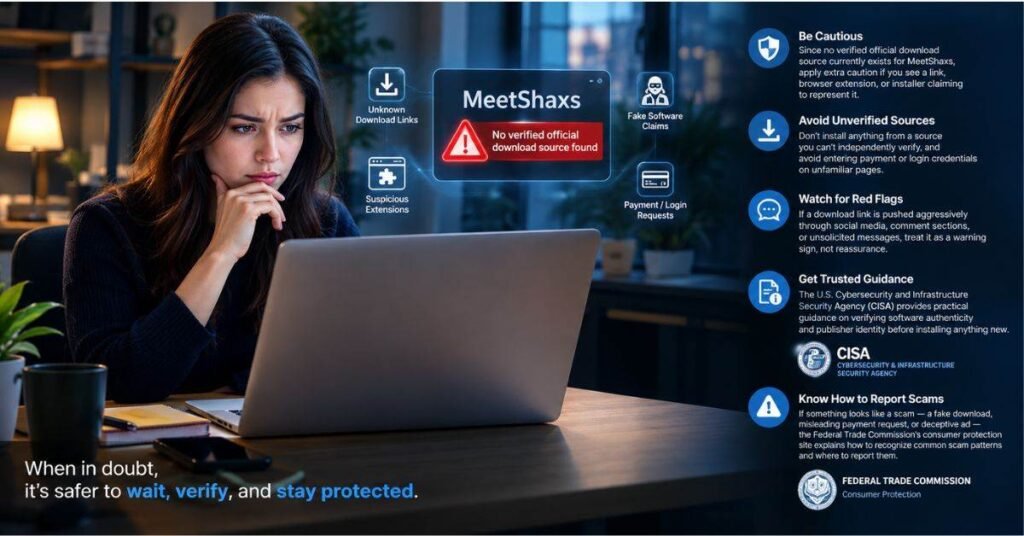
Because no verified official download source currently exists for MeetShaxs, some extra caution is worth applying if you ever encounter a link, browser extension, or installer claiming to represent it. The same caution applies to any unfamiliar software with no confirmed publisher, regardless of its name.
Avoid installing anything from a source you can’t independently verify, and avoid entering payment or login credentials on a page that isn’t clearly tied to a known, checkable company. If a download link is pushed aggressively through social media, comment sections, or unsolicited messages, treat that as an added warning sign rather than reassurance. The U.S. Cybersecurity and Infrastructure Security Agency (CISA) publishes practical guidance on verifying software authenticity and publisher identity before installing anything new — a genuinely useful habit for evaluating any unfamiliar tool, not just this one.
If something ever does look like a scam — a fake software download, a misleading payment request, or a deceptive advertisement — the Federal Trade Commission’s consumer protection site explains how to recognize common scam patterns and where to report them.
What This Means Going Forward
It’s possible that “MeetShaxs” eventually becomes a fully launched, verifiable product, or that it remains what the current evidence suggests: a search trend without a confirmed company behind it. Either outcome is consistent with the approach used throughout this article — describe only what can be checked, and clearly flag what can’t.
If a genuine MeetShaxs company does launch in the future with a working website, transparent pricing, and independently verifiable reviews, this article can be revisited and updated to reflect that. Until then, readers are better served by an honest “this can’t currently be confirmed” than by a confident but unverifiable feature list.
Frequently Asked Questions
Is software name meetshaxs a real, downloadable app
No official, independently verifiable download or company could be confirmed as of this writing.
Is MeetShaxs safe to use
Since no confirmed official source currently exists, it’s best to avoid downloading anything under this name until a verified publisher can be identified.
Why do search results show so many different descriptions of MeetShaxs
Because no single official source exists, different websites appear to have filled in the details differently, and some of the most detailed articles openly acknowledge this inconsistency themselves.
Is meetshaxs.com the official company website
It functions as a blog publishing articles about the term, rather than as a working software product’s homepage with a signup or download available.
What should I use instead for team collaboration
Established, independently verifiable platforms such as Slack, Microsoft Teams, Zoom, or Google Workspace are a reasonable starting point, since their claims can be checked against public reviews and documentation.
Conclusion
Searching for software name meetshaxs and finding conflicting, hard-to-verify information isn’t a sign you did anything wrong — it reflects how search-driven content can sometimes outpace actual evidence. Based on everything currently checkable, no official, independently verifiable company or product could be confirmed under this name. What does exist is a set of widely shared articles, including some that openly acknowledge the inconsistency, describing the term in different and sometimes contradictory ways.
That’s not a reason to stop researching new software — it’s a reason to do exactly what this article did: compare sources, look for a single authoritative reference point, and treat confident-sounding claims with appropriate caution until they can be checked. That habit will serve you well with any new app, platform, or AI-branded tool you come across in 2026 and beyond, not just this one.
If you’re looking for reliable team collaboration software today, start with an established, independently verifiable platform, review its dated user feedback, and confirm any security claims directly through public certification records before committing. And if a genuine, independently verifiable MeetShaxs product does emerge with a real company behind it, that will be a development worth covering on its own merits.